
Table of Contents
Summary
There are different type of skins so to tackle these types there is also a different combination of moisturizers between gel cream, gel moisturizer and cream moisturizer they all help in hydrating the skin, they are different in the working but they work best in different situations. you can use gel if your skin is hot, oily and get acne easy in hot humid days as it is lightest among all, cream can be use when your skin is dry and cold in nature as it is the richest, gel cream can be use for those with the skin type that changes with the season.
Nobody has to pick one forever. Your skin changes, and your moisturiser can change with it.
Key takeaways
- Gel cream vs gel moisturiser comes down to body and comfort. A gel is thin, watery and fast. A gel cream is a little thicker and keeps skin comfortable for longer.
- Oily skin usually does best with a gel. If your skin feels shiny yet tight, a gel cream may suit you better.
- Combination skin often loves gel cream. It handles an oily T zone and drier cheeks without feeling heavy.
- Dry skin needs more support. A cream, or a gel cream in mild weather, helps hold moisture in.
- Dry and dehydrated are not the same thing. Dry skin lacks oil. Dehydrated skin lacks water, and even oily skin can be dehydrated.
- Your climate matters as much as your skin type. Choose lighter textures for summer and monsoon, a gel cream for AC offices, and a richer option for dry North Indian winters.
- SPF in a moisturiser helps, but it doesn’t replace sunscreen. Most people apply too little, so protection falls short. Add a dedicated sunscreen for long hours outdoors.
- A simple two hour mirror test beats guessing. Apply your moisturiser, leave your face alone, and check how your T zone and cheeks feel.
- Patch test anything new, and see a dermatologist if dryness, stinging or breakouts don’t settle.
Introduction
Your face feels oily by noon. By night, your cheeks feel tight. So you stand in front of the moisturiser shelf and wonder if you need a gel, a cream, or something in between.
Here is the short truth. Most guides only compare gel and cream. They skip the third option, which is the gel cream. That is a big gap, because gel cream is often the easiest pick for people whose skin changes with the weather or changes from one part of the face to another.
In this guide, you will learn how gel cream vs gel moisturiser really differs, which one suits your skin type, and what to use in an Indian summer, a rainy month, an air conditioned office or a dry North Indian winter. You will also get a simple skin test, an honest look at moisturiser with SPF, and a routine you can start tomorrow.
The quick answer
Gel moisturiser is light water based so if your skin is oily, acne prone based if weather gets hot, so it performs very well in these conditions and get absorbed in the skin easily..
Gel cream comes in the middle one, if your skin changes according to the weather, gelly text make the skin feel more comfortable and smooth, so for the ones whose skin changes from oily to dry this is the best pick.
Cream moisturiser this is best for the dry and cold skin, cause it has a thicker texture, it keeps your skin moisturized.
There is no winner. The right pick depends on your skin type, your climate and how your skin feels today.
Gel, gel cream and cream: the texture ladder
Think of moisturisers as a ladder. Gel sits on the lowest rung and feels the lightest. Cream sits at the top and feels the richest. Gel cream sits in the middle.
| Gel moisturiser | Gel cream | Cream moisturiser | |
| Feel on skin | Cool, thin, bouncy | Cool, soft, slightly cushioned | Smooth, rich, plush |
| Absorption | Very fast | Fast | Slower |
| Finish | Fresh, often matte | Soft, natural | Dewy or satin |
| Best skin types | Oily, acne prone | Combination, normal, mildly dry | Dry, mature, sensitive |
| Best weather | Hot and humid | Changing seasons, AC rooms | Cold and dry |
| Watch out for | Can feel too thin on dry skin | Can feel heavy on very oily skin | Can feel heavy in heat |
All three hydrate your skin. They just deliver that hydration in different ways. That small difference decides how comfortable you feel at 3 pm.
What is a gel moisturiser?
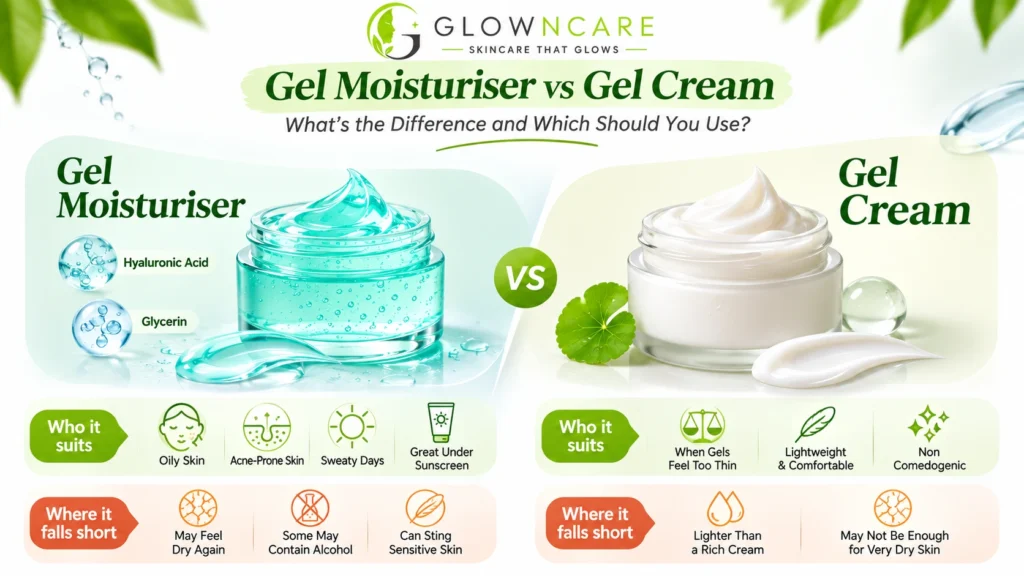
A gel moisturizer is a gel like structure and it is mostly made up of the water and have some humanectants like hyaluronic acid and glycerine, which helps in the keeping the moisturizer in upper layer of the skin and keep it smooth.
Who it suits
It suites on acne prone skins or oily skins, and some the days like when you sweat because of gel it will not leave any residue, and can be use as a base before the sunscreen.
Where it falls short
There is two thing one ios to read the list of ingredients ion your gel moisturizer, if it contain alcohol so try to avoid it because it may be sensitive to some skins, and the other is if you have high dryness then after applying gel moisturizer you feel that you skin gets dry again after 1 or 2 hours.
What is a gel cream?
A gel cream is a moisturiser that looks and feels like a gel but has a slightly thicker body. It spreads easily, feels cool on the skin, and sinks in quickly. It also leaves a bit more comfort behind than a plain gel.
Brands create gel creams for people who find gels too thin and creams too heavy. Most gel creams are made to be non comedogenic, which means they are designed not to block pores. Always check the label on your specific product.
Gel cream vs gel moisturiser: the real differences
- Body of the texture: A gel cream is a little thicker and softer. A gel is thinner and more watery.
- Comfort after a few hours: A gel cream usually keeps skin feeling comfortable for longer, especially in air conditioning.
- Oil control: A gel feels lighter on very oily skin. A gel cream can feel just right if your oil sits only in the T zone.
- Season flexibility: A gel cream stretches across more weather. A gel works best in the heat.
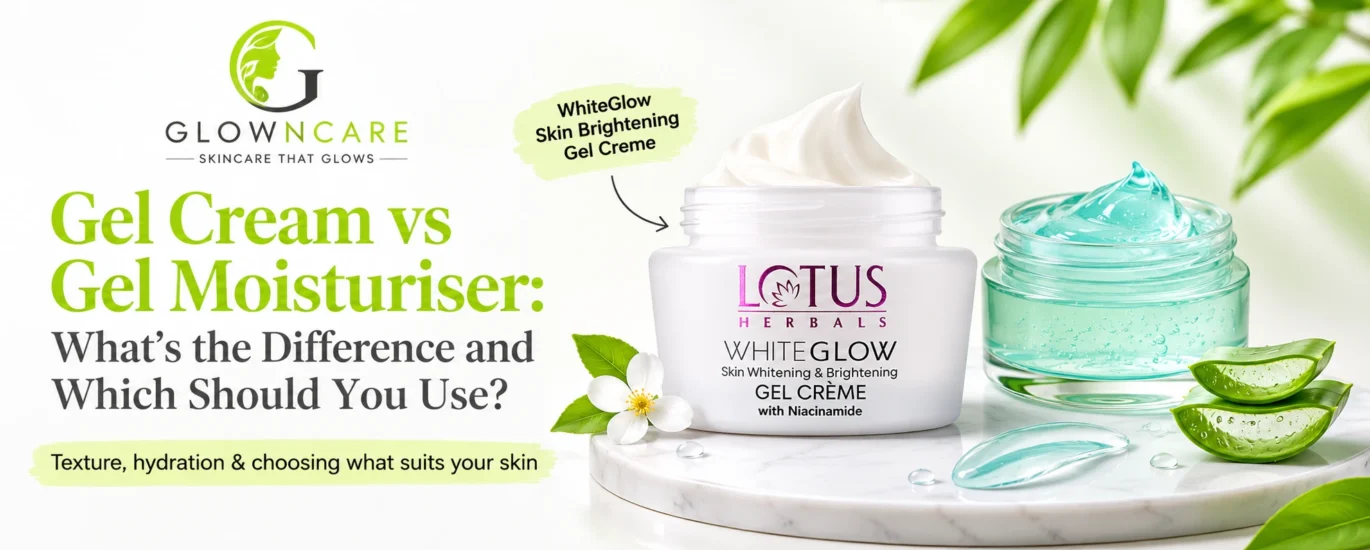
Lotus Herbals offers a well known Indian example in its WhiteGlow Skin Brightening Gel Crème SPF 25 PA+++. Lotus describes it as a lightweight gel and crème hybrid that feels non sticky and non greasy, and says it launched this style of formula in India about 15 years ago. It is a good example of what a gel cream aims to be: fresh like a gel, but a little more nourishing.
What is a cream moisturiser?
When the water and oil is mixed into a thicker texture, then the cream moisturizer is made consisting of emollients, which are responsible to make your skin soft, and occlusives, that helps to reduce the water from the skin. So ingredients like shea butter, ceramides and squalane are some of them included in creams.
Who it suits
Creams help dry, flaky, mature or sensitive skin. They also help in cold weather, when the air pulls moisture from your face.
Where it falls short
When you apply cream moisturizer in hot days it doesn’t look good on screen and shows up like a worst shiny type, it’ll be beneficial if you apply it on night or in winters.
Gel cream vs gel moisturiser by skin type
Oily skin
Start with a gel. It gives water without adding extra oil. If your skin feels tight right after washing, try a gel cream instead. Oily skin that still feels dry underneath often needs a little more comfort, not less moisturiser.
Acne prone skin
Pick a light gel or gel cream that says non comedogenic and fragrance free. Skip thick creams on areas that break out. Introduce one new product at a time, so you can tell what helps and what doesn’t.
Combination skin
Gel cream is the easiest answer. If your T zone shines but your cheeks feel dry, a gel cream usually balances both. You can also use a gel on the forehead and nose, and a cream on dry cheeks.
Dry skin
A cream gives the most support. In mild weather, a gel cream may be enough. If you notice flaking or tightness, move up a rung on the ladder.
Sensitive skin
Pick anyone from the simplest formulae and use it on the small part of the skin, and test that for couple of weeks and then see the results, before you take it to your face.
Dehydrated skin
Dry skin lacks oil. Dehydrated skin lacks water. You can have oily and dehydrated skin at the same time, which confuses many people. If your face feels shiny yet tight, you probably need more water based hydration, so a gel or gel cream often helps.
Men’s skin
The same rules apply. Many men like lighter textures because they apply quickly and don’t feel sticky. A gel or gel cream usually fits a busy morning.
Which one for your climate? The India season swap
Your skin changes with the weather. Your moisturiser can change too.
| Season or setting | What to try | Why |
| Hot summer and humid cities | Gel, or a light gel cream | Heavy textures feel sticky when you sweat |
| Monsoon | Gel or gel cream | Humid air already gives your skin some moisture |
| AC office all day | Gel cream | AC air dries skin even when the weather is hot outside |
| North Indian winter | Gel cream or cream | Dry, cold air pulls water from the skin |
| Dusty, polluted days | Light layer, cleanse well at night | Thick layers can trap dirt and make skin feel heavy |
You don’t need to buy a new product for every season. Many people do well with one gel or gel cream for most of the year, and a richer cream for the coldest weeks.
The two hour mirror test
Not sure which texture you need? Try this simple check. It is a practical self test, not a medical one.
- Wash your face and apply a small amount of your moisturiser.
- Leave your face alone for two hours. Don’t blot, touch or add anything.
- Look at your face in natural light.
- If your T zone is very shiny but your cheeks feel fine, try a lighter texture.
- If your cheeks feel tight or look flaky, try a richer texture.
- If your T zone shines and your cheeks feel tight, try a gel cream, or use two textures on different areas.
Repeat the test for a few days. Your skin gives clearer answers than any chart can.
Can you use gel and cream together?
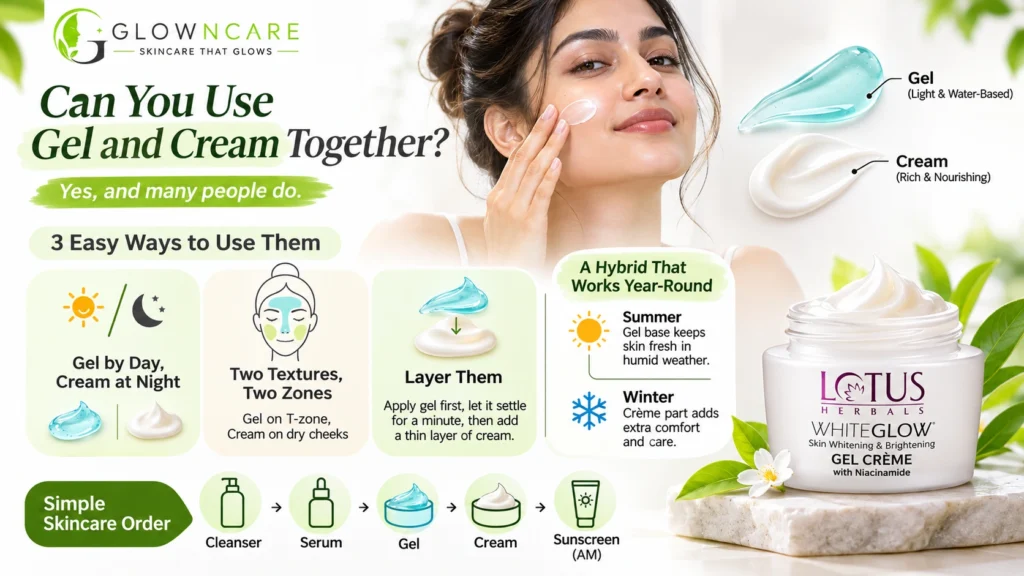
Yes, and many people do. Here are three easy ways.
- Gel by day, cream at night. This works well if you wear sunscreen and makeup in the morning and want extra care before bed.
- Two textures, two zones. Use a gel on the T zone and a cream on dry cheeks.
- Layer them. Apply the gel first, let it settle for a minute, then add a thin layer of cream on top.
For a simple order, go from the thinnest product to the thickest: cleanser, serum, gel, cream, and sunscreen last in the morning. Use about a pea sized amount for your face. Slightly damp skin often feels more comfortable under a gel, though you don’t have to chase this.
If your skin swings between humid summers and dry winters, a gel cream makes this simpler, because one product covers more ground. Lotus says the gel base of its WhiteGlow Gel Crème suits humid weather, while the crème part helps in winter. That kind of flexibility is the whole point of the hybrid texture.
Moisturiser with SPF: what it can and can’t do
Many gel creams and moisturisers carry SPF. That helps, but it is not the full story.
What SPF 25 PA+++ means
SPF tells you how well a product protects against UVB rays, the ones that cause sunburn. An SPF 25 product blocks roughly 96 percent of UVB rays. PA tells you how well it protects against UVA rays, which reach deeper and add to ageing and tanning. PA+++ means high UVA protection.
Why a moisturiser with SPF is not a full sunscreen
The main problem is the amount you apply. People tend to spread moisturiser thinly. In a University of Liverpool study, 60 people applied a sunscreen on one visit and a moisturiser with SPF 30 on another. The researchers found the moisturiser did not give protection on the same level as the sunscreen. Using only half the right amount can cut protection by as much as two thirds.
Layering doesn’t fix this either. Two SPF products on your face do not add up to a higher SPF.
What to do instead
- Apply about two finger lengths of any SPF product to your face and neck.
- If you spend a long time outdoors, use a dedicated broad spectrum sunscreen on top.
- Reapply about every two hours when you are in direct sun.
Think of SPF in your moisturiser as a helpful base layer on a normal day. It is a bonus, not a replacement.
A simple morning and night routine
Morning
- Wash your face with a gentle cleanser.
- Apply a serum if you use one.
- Apply your gel or gel cream.
- Finish with sunscreen if you will be outside for long.
Night
- Cleanse your face well.
- Add any treatment your skin needs.
- Use a gel cream in mild weather, or a cream in cold, dry weather.
If you want a morning gel cream with built in SPF, the Lotus WhiteGlow Skin Brightening Gel Crème SPF 25 PA+++ is one option to consider. According to Lotus, it contains niacinamide, milk enzymes, grape extracts and saxifraga extracts. Lotus says it helps reduce the appearance of dark spots, tanning and uneven tone, and that people may see brightening in as little as 7 days with regular use. Results vary from person to person, so treat that timeline as the brand’s claim, not a promise. Lotus suggests using it twice a day on clean skin, and says to add a dedicated sunscreen when you spend long hours in the sun.
Check the current price and ingredients on the Lotus WhiteGlow Gel Crème page
Want ideas for wearing a lightweight moisturiser under makeup? Read our guide to the best lightweight moisturiser for oily skin in India.
What real people in India say about the WhiteGlow range
Ingredient lists and brand claims only tell part of the story, so we also read what people in India share in recent Reddit threads. These are personal opinions, not clinical results, and every skin reacts differently.
A pigmentation thread: “I’ve tried so many products, what actually works?”
In a recent thread, a person from India asked for help with stubborn pigmentation. She struggled with dark eyelids and under eyes, dark elbows, visible pores on oily skin and an uneven tone on her face, arms and body. Clinic visits hadn’t helped, and a body lotion, a body wash and a pigmentation cream hadn’t shown a change either. She asked others to share what really worked and how long it took. One commenter replied that her cousins use the Lotus WhiteGlow range and that her skin looks glowy whenever she stays at their place. She bought the gel crème herself, and her sister uses the face wash, which she finds quite hydrating. She added that the range has a few options, so you can pick what suits you. It is one person’s experience, but it shows what many readers look for: a light, hydrating gel cream for everyday use, and honest answers about how long skin takes to change.
Also look at this post on reddit’
A dull skin thread: the White Glow Lotus crème
In another thread, a user asked for product ideas for dull skin. One reply suggested a simple routine for dry and sensitive skin: a water based toner and serum, with sunscreen on top, and she said it gave her a slow glow over time. Another reply kept it even simpler: drink water, eat fruit, use water based creams and invest in a good mineral sunscreen. The original poster then shared an update. A Cetaphil toner worked well for her, and she was enjoying a White Glow Lotus crème, which she uses at night. She was honest that it had only been a week. That honesty is useful, because one week is early. Dull skin usually improves with lighter hydration, steady habits and daily sun protection, not with quick fixes.
None of these stories proves anything on its own. They do match what we explained above: lighter hydration, steady use and daily sun protection give your skin its best chance.
Also look at this post at reddit
Common mistakes to avoid
- Skipping moisturiser because your skin is oily. Dry, stripped skin can look shinier and feel worse.
- Using only a gel in dry winters. If your cheeks feel tight, add a gel cream or cream.
- Using a heavy cream in a humid city. It can feel sticky and may make you break out.
- Relying on SPF moisturiser alone. Thin layers rarely deliver the protection on the label.
- Washing your face too often. Over cleansing leaves skin tight and tempts you to pile on thicker products.
- Changing products too fast. Give each new product a patch test and a couple of weeks before you judge it.
When to see a dermatologist
Book an appointment if dryness doesn’t improve, your skin stings or burns, you notice a rash, or breakouts keep returning. These can be signs of conditions such as eczema or rosacea, and a moisturiser alone won’t fix them. This article offers general information and does not replace medical advice.
Frequently asked questions
What is the difference between gel cream and gel moisturiser?
A gel moisturiser is thinner, more watery and very light. A gel cream is a little thicker and more cushioned, so it feels more comfortable for longer while still feeling fresh.
Is gel cream better than gel moisturiser?
Neither is better for everyone. Gel suits oily skin and hot weather. Gel cream suits combination skin and changing seasons.
Is gel cream good for oily skin?
Often yes, especially if your skin feels tight or dehydrated despite the shine. If your skin is very oily, start with a plain gel and see how you feel after two hours.
Can combination skin use gel cream?
Yes. Gel cream is one of the easiest choices for combination skin, because it balances an oily T zone and drier cheeks.
Which is better in summer, gel or cream?
Gel or a light gel cream. Heavy creams tend to feel sticky in heat and humidity.
Can I use a gel moisturiser in winter?
You can in mild winters, especially with a cream at night. In dry, cold places, you may need a gel cream or cream.
Can I use gel and cream together?
Yes. Use gel by day and cream at night, or layer a thin cream over a gel on dry areas.
Does gel moisturiser clog pores?
Most gels are light and made not to clog pores, but it depends on the formula. Look for non comedogenic on the label and patch test first.
Can gel moisturiser go under sunscreen?
Yes. Gels spread thinly and usually sit well under sunscreen. Let the gel settle for a minute before you apply sunscreen.
Is a moisturiser with SPF enough?
For a normal day with little sun, it can help. For long or direct sun exposure, use a dedicated sunscreen as well.
What does SPF 25 PA+++ mean?
SPF 25 shows UVB protection against sunburn. PA+++ shows high protection against UVA rays.
How do I know if my skin is dry or dehydrated?
Dry skin lacks oil and often looks flaky. Dehydrated skin lacks water and may look dull or tight, even when it is oily.
Can men use gel cream?
Yes. Skin needs don’t depend on gender, and many men like gel creams for their light feel.
The final takeaway
Pick gel when your skin is oily and the weather is hot. Pick cream when your skin is dry and the air is cold. Pick gel cream when you live somewhere in between, or when your skin can’t make up its mind.
Test your choice with the two hour mirror test, adjust with the seasons, and always pair your daytime routine with proper sun protection. If you want a single light, SPF carrying option to try, the Lotus WhiteGlow Gel Crème SPF 25 PA+++ is worth a look.
About the Author
This guide comes from the GlownCare team. We write for people in India who want honest answers about gel cream vs gel moisturiser, SPF, dry versus dehydrated skin and everyday routines that fit real weather. We check ingredients, separate brand claims from proven results, and tell you when a product may not suit your skin type. The brands we write about do not pay us, and we don’t earn affiliate commissions from them. Skin reacts differently from person to person, so treat this article as general information and not medical advice. Have a question or a correction? Contact us, and browse more in our skincare guides.