


Table of Contents
Summary
After you wash your face you notice that your skin gets tiger but why, it is because th faceewash and cleanser you use it pulls the water and natural oils from the skin, faster than your skin hold to them. As the outer layer dries, and the nervous system tell this stretchiness feeling to the brain, means you don’t need to worry if a short tightness just skin telling you to go easy.
Key takeaways
- Squeaky clean doesn’t mean clean. Your face should feel soft and comfortable after washing, never stretched.
- A harsh cleanser is the most common cause. Strong sulfates, high alcohol and alkaline soap strip your skin barrier along with the dirt.
- Hot water, over washing and hard scrubbing make it worse. Lukewarm water is the safer pick.
- Leftover cleanser can add to the pulling feeling, so rinse until your skin stops feeling slippery.
- Oily skin can still be dehydrated. A strong face wash can leave you tight now and shiny later.
- In India, hard water, dry winters and air conditioning can all push skin toward tightness.
- Pat dry and moisturize while your skin is still a little damp to help it hold on to water.
- Look for a gentle, pH friendly cleanser with mild cleansing agents, glycerin and ceramides, and patch test anything new.
- See a dermatologist if tightness comes with burning, cracking, itching or redness that won’t settle, or if it doesn’t improve after two weeks of a gentler routine.
Introduction
You know the moment. You splash your face, work up a lather, rinse, and reach for the towel. Then it hits you. Your cheeks feel stretched, your forehead feels tight, and when you smile, your skin tugs back like a rubber band. You may even think, “Well, at least it’s clean.”
Here’s the thing. That squeaky clean feeling isn’t the proof of a good wash that many of us were taught it was. When your skin feels tight after washing your face, it’s often telling you that it lost more than dirt and oil. It also lost water and some of the natural lipids that keep your skin barrier strong.
The confusing part is that this happens to almost everyone at some point. Dry skin feels it, and so does oily skin, sensitive skin and acne prone skin. Some people blame their face wash. Others blame the weather, the water at home, or even their own skin. Honestly, they could all be partly right.
So in this guide, we’ll sort it out together in plain words. You’ll learn what’s really happening inside your skin, why a little tightness can be normal while daily tightness is a warning sign, and how to find your own cause with a quick Tightness Decoder. We’ll also look at how hard water, dry Indian winters and air conditioning play a part, how to pick a gentle cleanser by reading the label, and a simple 7 day plan to get your skin feeling comfortable again.
Let’s start with what’s going on beneath the surface.
Why your face feels tight after washing
You rinse off, pat your face dry, and suddenly your cheeks feel two sizes too small. You smile and your skin tugs back. Plenty of people take that as a sign their face is spotless. I’d say it’s usually the opposite. Your skin lost more than dirt.
See tightness feeling is not bad if it is only for a short period of time but not for longer and it happens because after you wash your face natural oils also get removed with the dirt from the skin, so the outer layer gets dry and your nervous systems sends this signal to the brain that the natural oils gets removed and skin get tight, so it shows you that your skins are telling that you should change your face cleanser.
In this guide, we’ll walk through what’s happening inside your skin, how to spot your own cause, and how to fix it. You’ll also get a simple 7 day plan and clear signs for when it’s time to see a doctor.
What’s actually happening inside your skin?

Your skin has a protective outer layer called the stratum corneum. Picture a brick wall. Your skin cells are the bricks, and natural oils like ceramides and other lipids are the mortar holding everything together. That wall is your skin barrier, which some people call the moisture barrier. It keeps water in and irritants out.
When you wash your face, your cleanser lifts away dirt, oil, sunscreen and makeup. A strong one also takes some of the mortar with it, along with natural moisturizing factors, the tiny molecules that help your skin hold water. Your skin then loses water through the surface faster than usual. Experts call that transepidermal water loss.
Now for something most blogs skip. Researchers at Stanford University, working with L’Oréal, studied this exact feeling and published their findings in PNAS Nexus. They found that cleansing makes the outer layer contract. That mechanical pull travels down to mechanoreceptors below the surface, and those send signals to your brain that you feel as tightness. So the tight feeling isn’t just in your head. Your skin really is pulling, and your nerves really do notice.
Soap makes things worse. Dermatologist Dr Zoe Diana Draelos explains that soap has a high pH, which swells the outer layer and lets the soap sink deeper than it should. After you rinse, the extra water leaves, and your skin ends up holding less water than before.
The way you rinse matters too. An older cosmetic chemistry study found a strong link between how much cleanser stays on your skin and how tight the skin feels. What you wash with counts, and so does how well you wash it off.
Is it normal for your face to feel tight after washing?
Sometimes, yes. Skin can feel a little stretched after cleansing, especially in cold or dry weather. If that feeling fades within a few minutes and your skin looks calm, you can relax.
Here’s a simple rule to keep in mind:
- Mild tightness that disappears quickly is normal.
- Tightness after every wash, especially with redness, stinging, flaking or dull skin, means something in your routine needs to change.
This also answers a question many people ask. Does tight skin mean your face is clean? Not really. Clean skin feels comfortable, soft and fresh. That squeaky feeling often means your cleanser stripped more than it should have.
The Tightness Decoder: what is your skin telling you?
Think of this as a quick check in the mirror. Find the line that sounds most like you.
Tight within seconds, all over your face. Your cleanser is probably too harsh, or its pH is too high. Check the label for strong sulfates, alcohol or alkaline soap.
Tight 10 to 30 minutes later. Your skin is losing water as it dries. You might have skipped moisturizer, or your skin could be dehydrated.
Tight only on your cheeks. Cheeks tend to be the driest part of the face. Hot water, hard scrubbing and washing too often hit them first.
Tight with redness or stinging. Your barrier may be damaged. Fragrance, exfoliating acids, retinoids and over washing are common triggers.
Tight even after plain water. Think about hard water, very dry air, cold weather, or skin that’s already on the dry side.
Tight and flaky. You may be over exfoliating, or your retinoid or acne treatment may be drying you out.
8 common reasons your face feels tight after washing
1. A harsh cleanser
Strong detergents pull away oil and moisture together. Look out for sodium lauryl sulfate, high levels of alcohol, and alkaline bar soap. Even oily skin can feel tight when a cleanser is too strong.
2. Hot water
A steaming wash feels lovely, but hot water pulls oils out of your skin faster. Lukewarm is kinder. A 2026 clinical study on facial cleansing reported that cool water kept skin hydration as well as warm water did, so you really don’t need heat to get clean.
3. Washing too often or scrubbing hard
Gym, commute, evening wind down. Plenty of us wash our face three times before bed. Every wash removes a little more protection. Stick to twice a day, and if your face feels fine and you only want a refresh, rinse with water alone.
4. Cleanser left on your skin
Rinse in a hurry and a thin film can stay behind, which adds to that pulling feeling. Keep rinsing until your skin no longer feels slippery.
5. Hard water
Many Indian cities have hard water, which carries a lot of calcium and magnesium. It may leave residue on your skin and make cleanser harder to rinse off. The research is still growing, so treat it as a possible contributor, not the only cause. Here’s a handy test. If your skin feels tight after every wash at home but not when you travel, your water could be part of the story.
6. Active ingredients
Retinoids, AHAs, BHAs and acne treatments can dry you out. If you use them, choose a gentle cleanser and pause scrubs while your skin settles.
7. A weak barrier or a skin condition
Eczema, rosacea and contact dermatitis weaken the barrier, so tightness shows up more often. A cleanser can’t treat these. We’ll cover when to see a doctor in a moment.
8. Dry air and skipping moisturizer
Cold weather, heaters and air conditioning all pull moisture from your skin. If you skip moisturizer after washing, nothing stands in the way of that dryness.
Why oily skin can feel tight after face wash
This one surprises people. Oily skin can still be dehydrated, because oil and water are two different things. Your face can make plenty of oil and still run short on water.
When a strong cleanser strips your skin, it often makes extra oil to make up for the loss. That’s why your face can feel tight right after washing and greasy a few hours later. So you wash again, and the cycle keeps going.
Shiny T zone but tight cheeks? You don’t need two cleansers. Use one gentle cleanser, spend a little more time on your T zone, and go lightly over your cheeks. A light, oil free moisturizer keeps oily and combination skin comfortable without that heavy feeling.
Skin type guide: what to change for your skin
Dry skin: Choose a creamy or gentle gel cleanser, wash with lukewarm water, and moisturize while your skin is still slightly damp.
Oily skin: Skip the very strong face washes. A gentle foaming or gel cleanser removes oil without leaving you tight.
Combination skin: One balanced cleanser does the job. Just change your pressure from zone to zone.
Sensitive skin: Go for a mild, soap free cleanser, and test anything new on a small patch first.
Acne prone skin: Stronger isn’t better here. Over washing and harsh products can irritate skin and make breakouts worse. A gentle, non comedogenic cleanser pairs well with any treatment your dermatologist gives you.
Mature skin: Natural oil production slows with age, so tightness shows up more easily. Look for a cleanser with moisturizing ingredients.
Why tight skin is so common in India
Where you live changes how your skin feels after washing. A few very Indian realities make tightness more likely:
- North Indian winters. Cold, dry air pulls moisture out of your skin fast.
- Air conditioned offices. Hours in cool, dry air leave skin thirsty by evening.
- Hard water. It’s common in many cities, and it may make rinsing harder.
- Pollution and sunscreen. You want a clean face at night, which tempts people to scrub or double cleanse too often.
- Humid coastal cities. Skin feels sticky, so people grab stronger face washes and overdo it.
If you live somewhere dry or with hard water, a gentle cleanser, lukewarm water, a thorough rinse and a good moisturizer matter even more.
Dry skin, dehydrated skin or a damaged barrier?
These three get mixed up all the time, so here’s a quick way to tell them apart.
- Dry skin lacks oil. It often feels rough and flaky, and it stays that way.
- Dehydrated skin lacks water. It can feel tight even when it looks oily, and it often looks dull.
- A damaged skin barrier shows up as stinging, redness and sensitivity, even to products that used to feel fine.
You can have more than one at once. The good news is that the fix starts the same way for all three: a gentle cleanser, lukewarm water, and moisturizer.
How to wash your face without the tight feeling
- Wet your face with lukewarm water.
- Use a small amount of gentle cleanser.
- Massage lightly for a short time. Skip the scrubbing.
- Rinse well, until your skin no longer feels slippery.
- Pat your face dry with a soft towel. Don’t rub.
- Apply moisturizer while your skin is still slightly damp.
Wash twice a day, once in the morning and once at night. If you wore sunscreen or makeup, a gentle cleanse at night is enough for most people.
How to choose a gentle cleanser that doesn’t strip your skin
Read the label, not just the front of the bottle. Here’s what to look for.
Avoid these if your skin feels tight:
- Alkaline bar soap
- High levels of alcohol, such as ethyl alcohol or alcohol denat
- Strong sulfates, including sodium lauryl sulfate
- Heavy fragrance, if your skin is sensitive
Look for these:
- Mild cleansing agents, such as decyl glucoside and cocamidopropyl betaine
- Humectants like glycerin and sodium hyaluronate, which help skin hold water
- Barrier friendly ingredients, such as ceramides and squalane
- A slightly acidic pH that suits your skin
- Labels like non comedogenic and dermatologist tested
One easy trick: check the first five ingredients. They make up most of the formula.
A real example: Dermacy Gentle Cleansing Face Wash
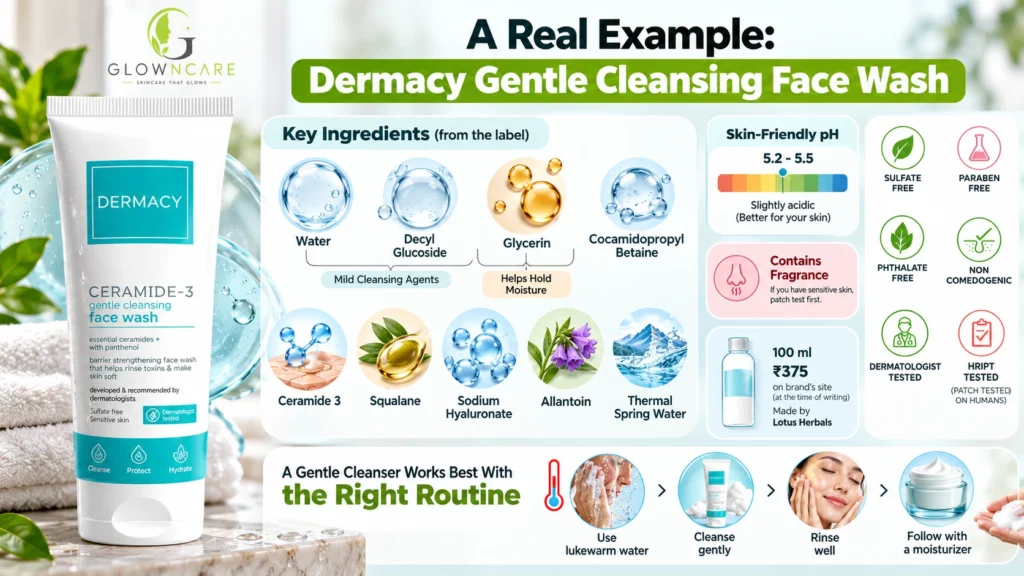
Let’s read one label together. Dermacy Gentle Cleansing Face Wash lists water, decyl glucoside, glycerin and cocamidopropyl betaine near the top. Decyl glucoside and cocamidopropyl betaine are mild cleansing agents, and glycerin is a humectant that helps skin hold moisture. Further down, you’ll find ceramide 3, squalane, sodium hyaluronate, allantoin and thermal spring water.
The brand lists its pH as 5.2 to 5.5, which sits in the slightly acidic range that suits skin better than the high pH of soap. According to the brand, it’s sulfate free, paraben free, phthalate free, non comedogenic, dermatologist tested and HRIPT tested, which means it went through a patch test on human volunteers. It’s made by Lotus Herbals, comes in a 100 ml bottle, and costs ₹375 on the brand’s site at the time of writing.
One honest note. The ingredient list includes fragrance, so if your skin reacts easily to scented products, patch test it first. No cleanser suits everyone, and a face wash can’t treat a skin condition.
A gentle cleanser is one piece of the puzzle. Your water temperature, your rinse and your moisturizer matter just as much.
The 7 day reset plan for tight, stripped skin
Day 1 and 2: Switch to a gentle cleanser and wash with lukewarm water only.
Day 3: Pause scrubs and strong exfoliating acids.
Day 4: Apply a simple moisturizer to damp skin after every wash.
Day 5: Check your rinse and your towel. Pat, don’t rub.
Day 6: Wear sunscreen in the morning and cleanse it off gently at night.
Day 7: Go back to the Tightness Decoder and notice what changed.
Most people feel more comfortable within a week of a gentler routine. If you don’t, it’s time to talk to a dermatologist.
When to see a dermatologist
Tightness is often just a routine problem, but sometimes it points to something else. See a doctor if you notice:
- Redness or burning that doesn’t settle
- Cracking, bleeding or intense itching
- Patches of rough, scaly or inflamed skin
- Tightness that doesn’t improve after two weeks of a gentle routine
Conditions like eczema, rosacea and contact dermatitis need a proper diagnosis. No face wash can treat them.
Common myths about tight skin after washing
“Tight means clean.” Clean skin feels comfortable. Tightness usually means your skin lost moisture and oils.
“Oily skin needs a stronger wash.” Strong washes can strip oily skin and trigger even more oil later.
“A toner will fix it.” A toner can’t rebuild your barrier. A gentle cleanser, a thorough rinse and a moisturizer do far more.
“I should stop washing my face.” You don’t need to. Your skin still needs cleansing. Change how you wash, not whether you wash.
FAQs
Is it normal for my face to feel tight after washing?
A little tightness that fades quickly can be normal, especially in dry or cold weather. Tightness after every wash is a sign to change your cleanser or routine.
Does tight skin mean my face is clean?
No. Clean skin feels soft and comfortable. That tight, squeaky feeling often means your cleanser removed natural oils along with the dirt.
Why does my face feel tight after washing even with a gentle cleanser?
Look at your water temperature, your rinse and your moisturizer routine. Hard water, dry air, actives like retinoids and a weak barrier can all cause tightness, even with a mild cleanser.
Why does my oily skin feel tight after face wash?
Oily skin can be dehydrated. A strong face wash removes oil and water, and your skin may then make more oil to catch up.
Why does my skin get oily after washing?
Your skin keeps making oil after you wash. If the wash was harsh, it may make extra to make up for the loss.
Can face wash cause dry and oily skin at the same time?
Yes. A harsh wash can leave skin tight right away and oily later, especially if your skin is oily and dehydrated.
Can over cleansing damage my skin barrier?
Yes. Washing too often, scrubbing and using strong products can weaken the barrier and cause dryness, redness and sensitivity.
Should I moisturize right after washing my face?
Yes. Moisturizing while your skin is still slightly damp helps lock water in and eases that pulling feeling.
How long does tightness after washing last?
Mild tightness fades within minutes. If it lasts for hours or comes back after every wash, your routine probably needs a change.
Does hard water make my face feel tight?
It may. Hard water can leave residue and make rinsing harder. If the tightness only happens at home, hard water could be part of the cause.
Should I stop using face wash if my skin feels dry?
No. Switch to a gentle, non stripping cleanser and use lukewarm water instead.
Which face wash ingredients cause tightness?
Strong sulfates like sodium lauryl sulfate, high levels of alcohol, alkaline soap and heavy fragrance are common triggers, especially for sensitive skin.
What water temperature is best for washing my face?
Lukewarm is a safe choice. Very hot water can strip oils faster.
When should I see a dermatologist?
See one if tightness comes with persistent redness, burning, cracking or itching, or if it doesn’t improve after two weeks of a gentle routine.
Final thoughts
After you wash your face, it should feel clean, soft and comfortable. Tightness is a message from your skin, not a badge of clean. Choose a gentle cleanser, use lukewarm water, rinse well, pat dry, and moisturize while your skin is still damp. Give it a week, then see how your skin feels.
About the Author
We’re the team behind GlownCare, a skincare blog built to make skin, hair and everyday wellness easier to understand. We started it because good skin advice often gets lost between ads, myths and complicated labels. So we do the digging and explain it in plain words.
For this guide, we went through dermatology research, including the Stanford and L’Oréal study on why skin feels tight after washing, and read product labels line by line. Our aim is simple. You should walk away knowing what’s happening in your skin barrier, why a gentle cleanser matters, and what small habits can make your skin feel comfortable again.
We’re not here to sell you a miracle. When we mention a product, we explain why, and we tell you honestly what to watch for, like patch testing. This article is for information only and doesn’t replace advice from a doctor. If your skin feels tight along with burning, itching, cracking or lasting redness, please see a dermatologist.